News · November 17, 2026 · 6 min read
Voyager 1 Is Now One Light-Day Away… And It's Still Talking to Us
On November 18, 2026, Voyager 1 becomes the first human-made object one light-day from Earth. How it got there, how we still hear it, and how long it has left.
 Watch the documentary
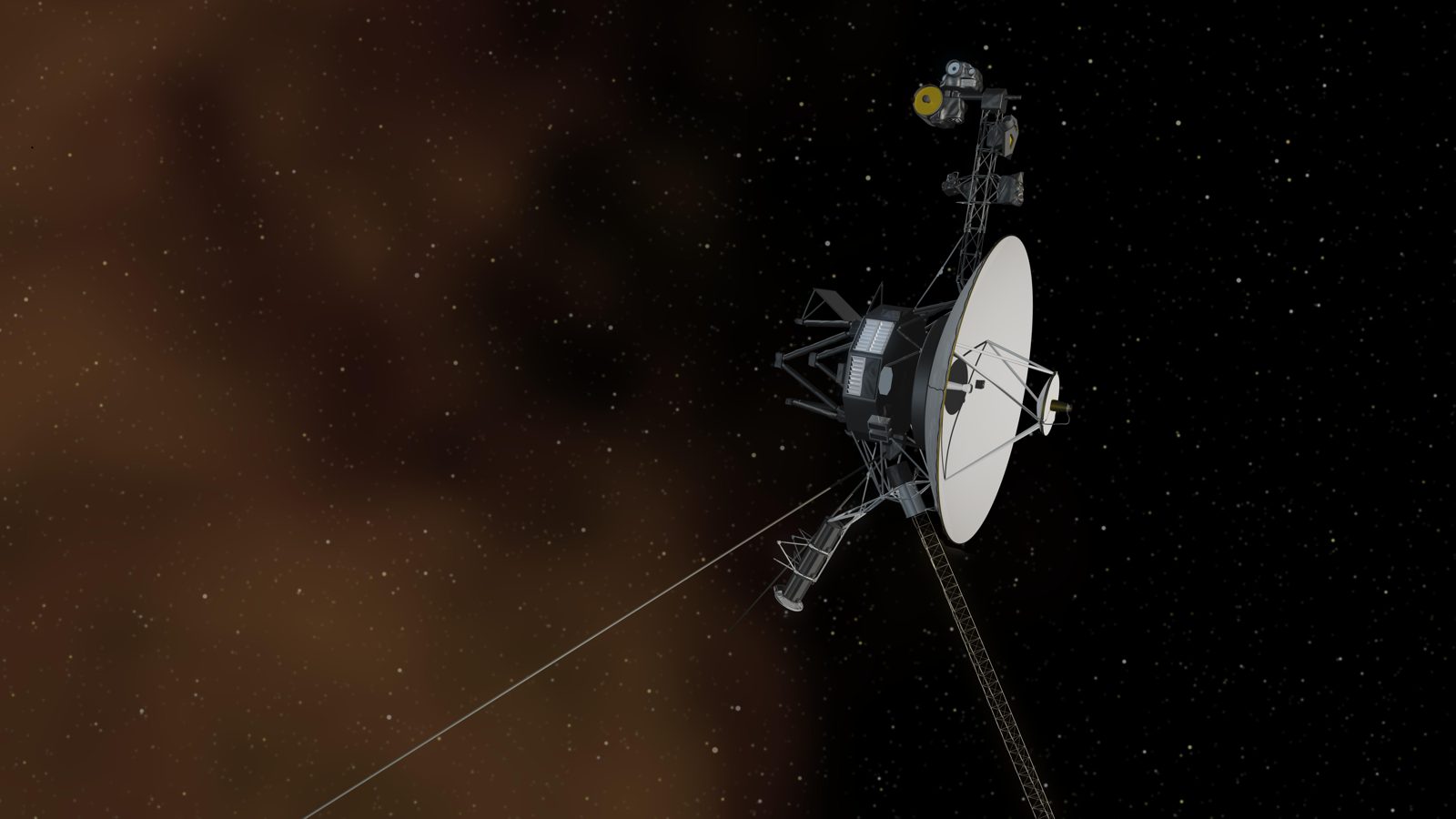
Voyager 1 entering interstellar space (artist concept). NASA/JPL-Caltech
In this story
On November 18th, 2026, a spacecraft built in the 1970s crosses a line no human-made object has ever crossed. If you send it a message, that message takes a full day to arrive. Twenty-four hours, travelling at the speed of light. And the reply takes another day to come back.
Voyager 1 is now one light-day from Earth. It has been flying for 49 years. Its computers have about 69 kilobytes of memory, less than a single photo on your phone. Its power is running out. And somehow, it is still talking to us. So how did a machine from 1977 get this far, how are we still hearing it, and how much longer does it have?
What one light-day means
Light is the fastest thing in the universe. It could circle the Earth more than seven times in a single second. Light from the Moon reaches us in just over one second. Light from the Sun takes about eight minutes. Now imagine light leaving Earth and travelling for an entire day, without stopping, and only then catching up with Voyager 1.
That is about 25.9 billion kilometres. Roughly 173 times the distance between the Earth and the Sun. Voyager 1 covers about 61,000 kilometres every hour. Even at that speed, it took 49 years, 2 months and 11 days to get here. Nothing we have ever built has been this far from home.
The launch and the Grand Tour
Voyager 1 launched on September 5th, 1977, a couple of weeks after its twin, Voyager 2. They left at a lucky moment. The outer planets were lining up in a way that happens only once every 175 years, letting a spacecraft swing from one planet to the next, using each planet's gravity to throw it further out. Voyager 1 reached Jupiter in 1979. It saw storms bigger than Earth, and discovered active volcanoes on the moon Io, the first ever seen beyond our planet.
In 1980 it reached Saturn, and flew close to its giant moon Titan, wrapped in a thick orange haze. That flyby bent its path up and out of the plane of the planets. From then on, Voyager 1 was not going anywhere else in the solar system. It was leaving. The mission was only designed to last about five years.
The Pale Blue Dot
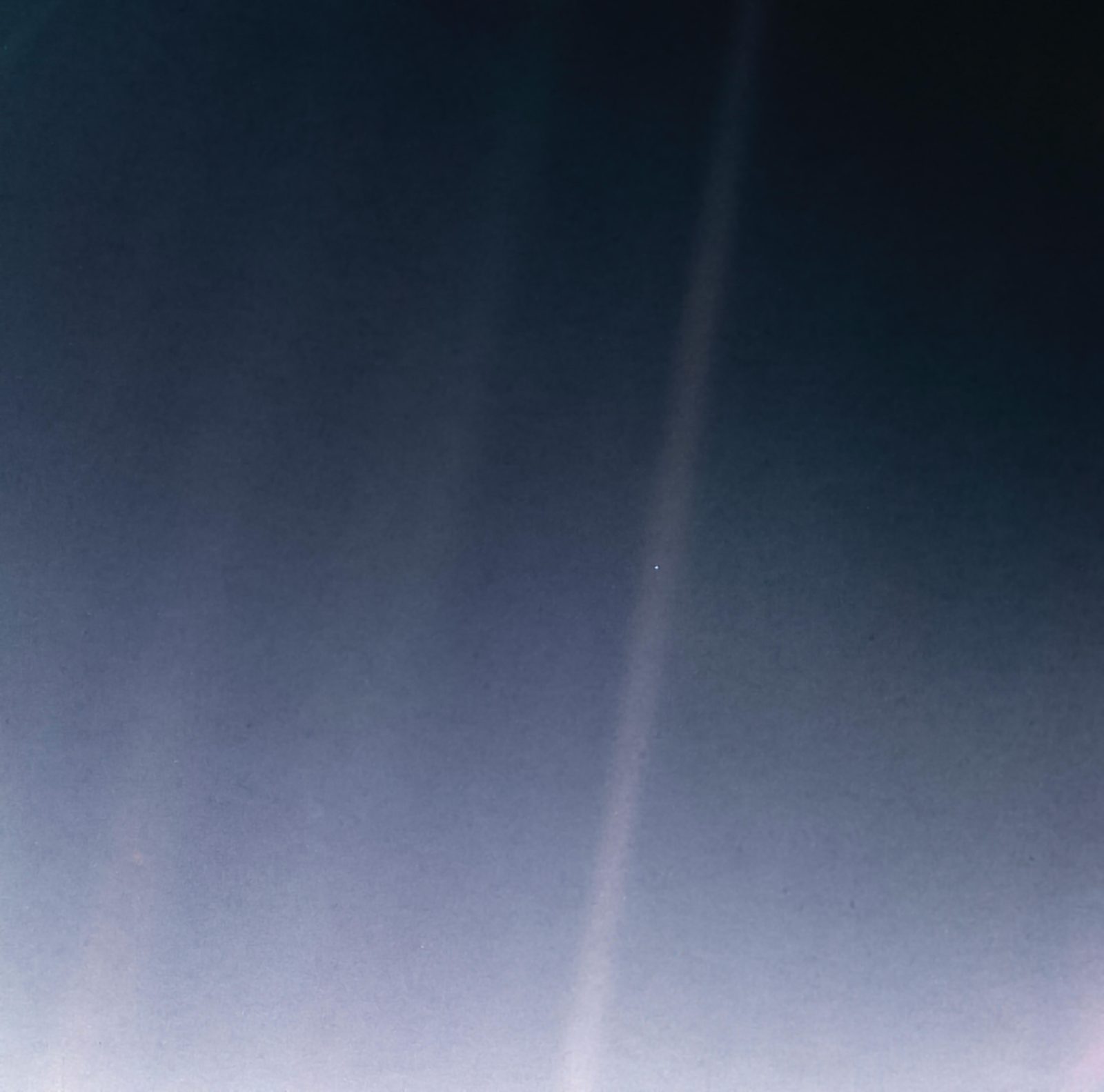
In 1990, about 6 billion kilometres from home, Voyager 1 turned its camera around one last time. At the suggestion of astronomer Carl Sagan, it took a picture of Earth. In that image, our whole planet is less than a single pixel. A tiny pale blue dot, caught in a beam of scattered sunlight.
Every person who has ever lived, every war, every empire, every discovery, all of it on that one speck. Soon after, the cameras were switched off to save power and memory. They have never been used again. The pale blue dot is the last picture Voyager 1 ever took.
Leaving the Sun's bubble
But the journey was far from over. The Sun constantly blows out a stream of charged particles called the solar wind. It carves out a giant bubble around the solar system called the heliosphere. At its edge, the heliopause, the solar wind finally runs into the thin gas between the stars.
In August 2012, Voyager 1 crossed that boundary. It became the first human-made object to reach interstellar space. The instruments that were still working noticed the change instantly. The particles from the Sun dropped away, and particles from the rest of the galaxy jumped up. For the first time, we were measuring the space between the stars directly, not from a distance, but from inside it.
Today, only Voyager 1 and Voyager 2 can do that.
How we still hear it
So how do you talk to something 25.9 billion kilometres away? Voyager 1's transmitter runs on about 23 watts. That's roughly the power of a fridge light bulb. By the time that signal crosses the solar system, it has spread out so much that it is almost nothing. Unimaginably faint.
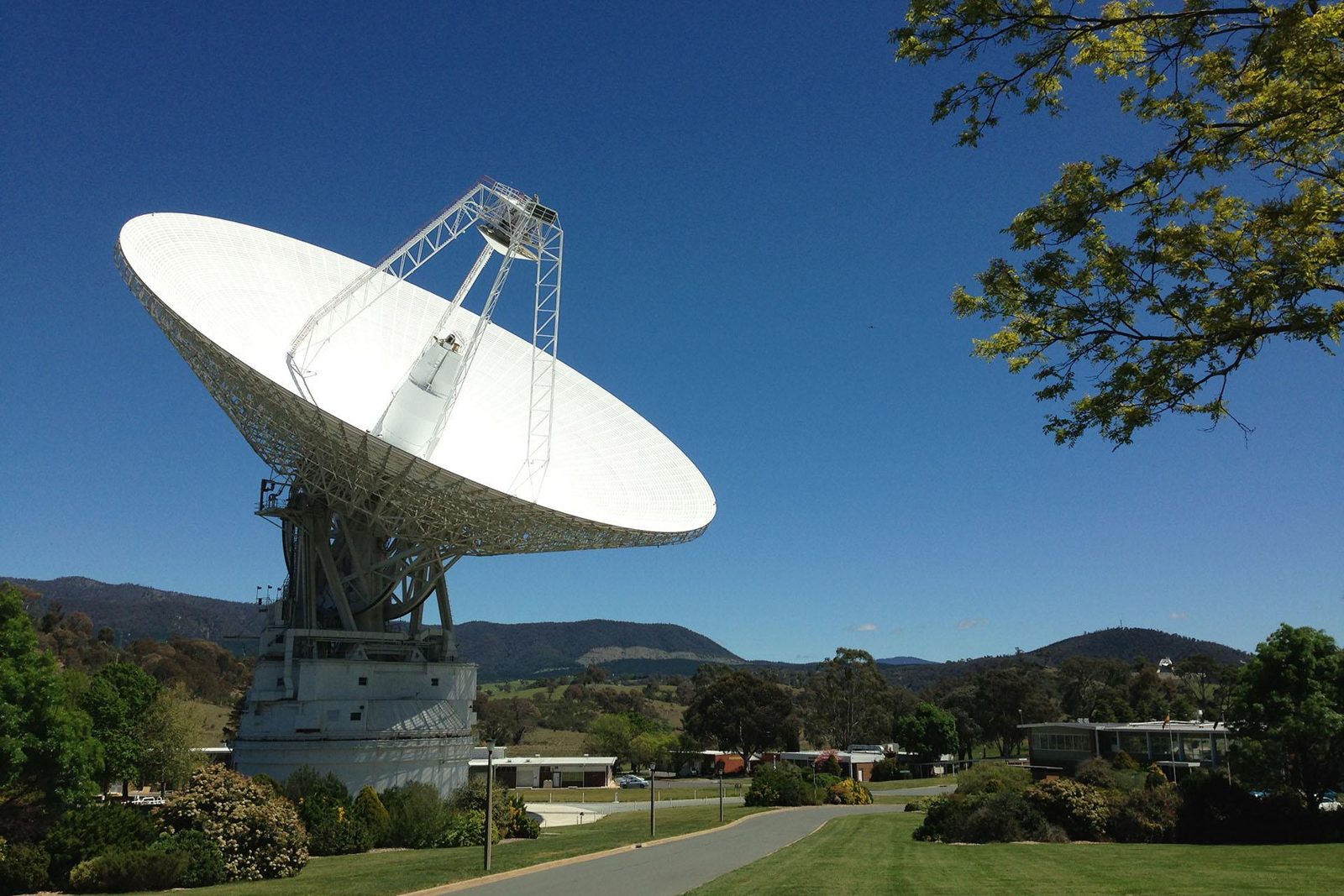
To catch it, NASA uses the Deep Space Network, giant radio dishes in California, Spain and Australia, the largest of them 70 metres across. They listen for a whisper from a machine that left Earth before the first personal computers were common. And the data comes back slowly. About 160 bits per second. Thousands of times slower than an ordinary home internet connection.
Every command sent to Voyager now takes a full day to arrive. If something goes wrong, engineers send a fix, and wait two days to find out if it worked.
The glitches
And things do go wrong. In November 2023, Voyager 1 suddenly started sending back nonsense. Its signal was still there, but the data made no sense. After months of detective work, engineers traced it to a single failed chip in one of its computers.
They couldn't replace it. So they rewrote the spacecraft's code from 24 billion kilometres away, moving it around the damaged memory, piece by piece. By the middle of 2024, Voyager 1 was sending real science again. Then, this October, it went silent. On October 18th and 19th, the Deep Space Network listened and heard nothing.
On October 20th, the signal came back. One set of thrusters had gone offline, and the spacecraft had switched to its backups on its own, and put itself in a safe mode. The team still doesn't know the exact cause. As NASA's mission manager put it, at this point, you have to expect the unexpected.
Running out of power
The biggest problem isn't glitches. It's power. Voyager 1 is powered by plutonium. As the plutonium decays, it gives off heat, and that heat is turned into electricity. But every year, it produces about 4 watts less.
Voyager 1 launched with 10 science instruments. Some were turned off after the planet flybys. Others were switched off one by one to save power. In April 2026, engineers shut down an instrument that had been running almost non-stop since 1977. It measured charged particles and cosmic rays for nearly 49 years. Today, Voyager 1 has just two science instruments left.
And there's another danger. The spacecraft is in the deep cold of interstellar space. If it gets too cold, its fuel lines could freeze. Then it couldn't point its antenna at Earth, and we would lose it forever. So in September, engineers tried something risky. They called it the Big Bang. All at once, they switched off three devices and switched on three lower-power replacements, while keeping the spacecraft warm.
It worked. Without it, Voyager 1 would have had to lose another instrument as early as next summer.
What happens next
The goal now is to reach the 50th anniversary, in September 2027. After that, every year will be a battle for watts. Sometime in the 2030s, there won't be enough power to run the transmitter. And Voyager 1 will go quiet. But it won't stop.
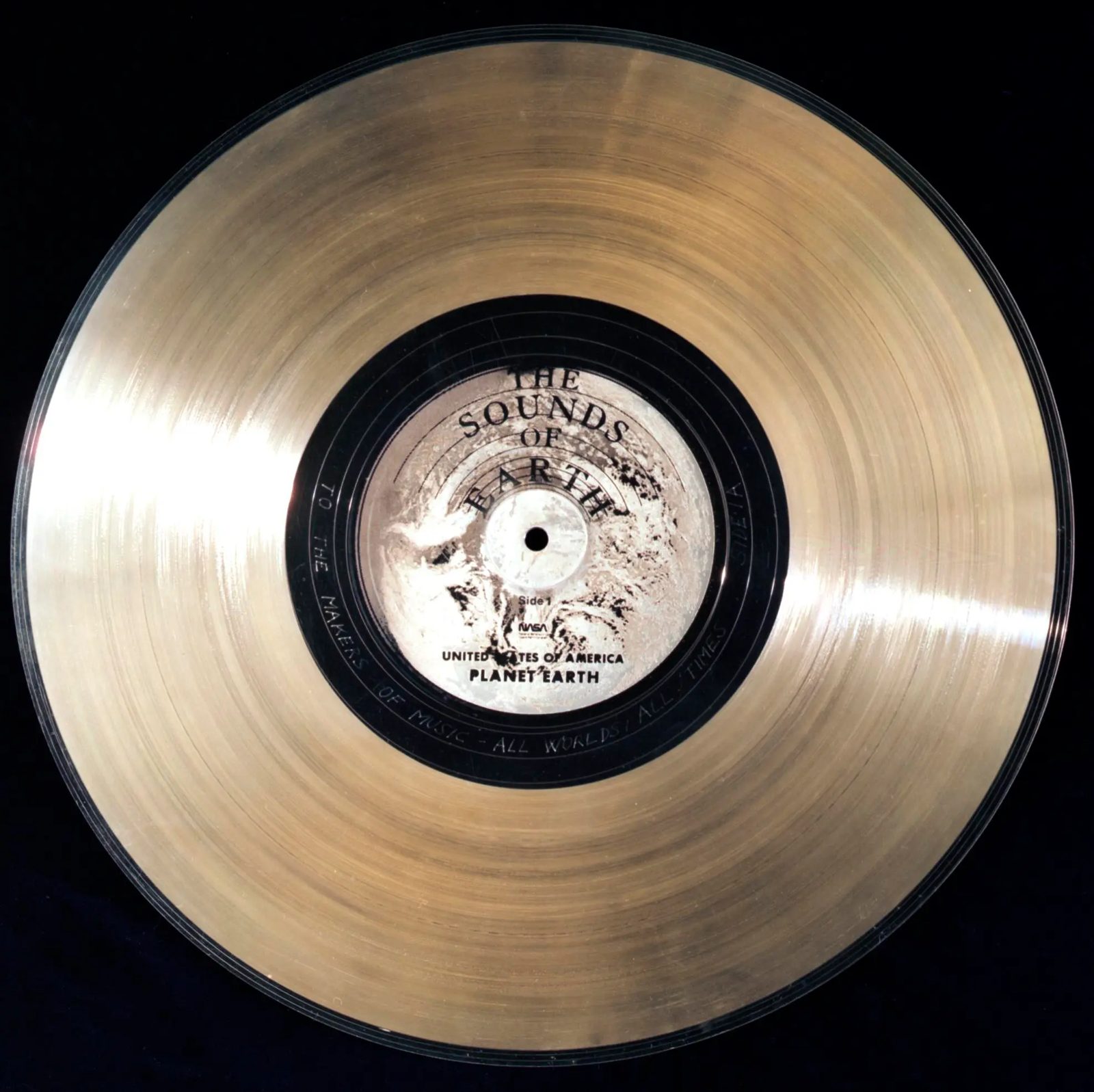
It will keep flying through the galaxy, at about 61,000 kilometres an hour, for millions of years. In about 40,000 years, it will pass within 1.6 light-years of a star called Gliese 445. And it carries a message. A golden record, with sounds and images from Earth. Greetings in 55 languages, music from around the world, the sound of rain, a heartbeat, a mother's kiss.
A message in a bottle, thrown into the cosmic ocean, just in case someone, someday, finds it.
Still listening
On November 18th, the signal from Voyager 1 will take a full day to reach us. Nothing about the spacecraft changes that day. It will just keep doing what it has done for 49 years. Flying outward, and calling home. Somewhere out there, a machine the size of a small car, built with 1970s technology, is still sending us messages from between the stars.
And for now, we are still listening.
This article is adapted from our documentary.
Watch on YouTube