Earth · 7 min read
What If Earth Lost Its Magnetic Field?
Earth's magnetic field shields us from the Sun every second. Where it comes from, what happens when it strains, and whether it is weakening now.
Aurora over low latitudes, May 2024.
In this story
In May 2024, millions of people looked up and saw something they had never seen before. The night sky was glowing pink, green, and purple. Not just in Norway or Alaska, but over Mexico, northern India, and southern Europe. It was the strongest solar storm in more than twenty years. Billions of tonnes of charged particles from the Sun had slammed into our planet.
And yet, almost nothing on the ground was harmed. Because something stopped it. Something invisible, wrapped around the entire Earth. Our planet's magnetic field.
Every second of every day, it shields us from the Sun. Most people never think about it. So what would happen if it disappeared?
A thousand-year mystery
People have been using Earth's magnetic field for nearly a thousand years, long before anyone understood it. By the eleventh century, Chinese navigators were using magnetised needles to find their way. Soon compasses spread across the world, guiding ships across oceans. But why did the needle always point north?
In 1600, an English physician named William Gilbert published a book called De Magnete. In it, he made a bold claim. The Earth itself, he said, is a giant magnet. He was right. But it would take more than three hundred years to work out where that magnetism actually comes from.
What the field actually is
To understand where it comes from, you have to go deep. About two thousand nine hundred kilometres below your feet. There, Earth's outer core is an ocean of liquid iron and nickel, around as hot as the surface of the Sun. That molten metal is constantly moving. Heat from the inner core makes it rise and sink, and Earth's spin twists it into giant spirals.
Moving metal creates electric currents. And electric currents create magnetic fields. Scientists call it the geodynamo. It's a self-sustaining engine that has been running for billions of years. The field it makes doesn't stop at the surface. It reaches tens of thousands of kilometres into space, forming a giant protective bubble called the magnetosphere.
On the side facing the Sun, it's squeezed to about sixty-five thousand kilometres. On the night side, it stretches into a long tail that reaches far beyond the orbit of the Moon.
The attack from the Sun
And it needs to be that big. The Sun constantly blows out a stream of charged particles called the solar wind. It hits Earth at around four hundred kilometres per second. That's more than a million kilometres per hour. Sometimes the Sun does something much more violent. It hurls out billions of tonnes of plasma in a single eruption, called a coronal mass ejection.
When these particles reach Earth, the magnetic field bends them away and sends most of them flowing around the planet. Some get trapped in two giant rings of radiation, called the Van Allen belts. And a few slip down along the field lines near the poles, where they crash into the upper atmosphere and make it glow.
That's what an aurora is. It's the visible edge of a battle that never stops.
When the shield strains
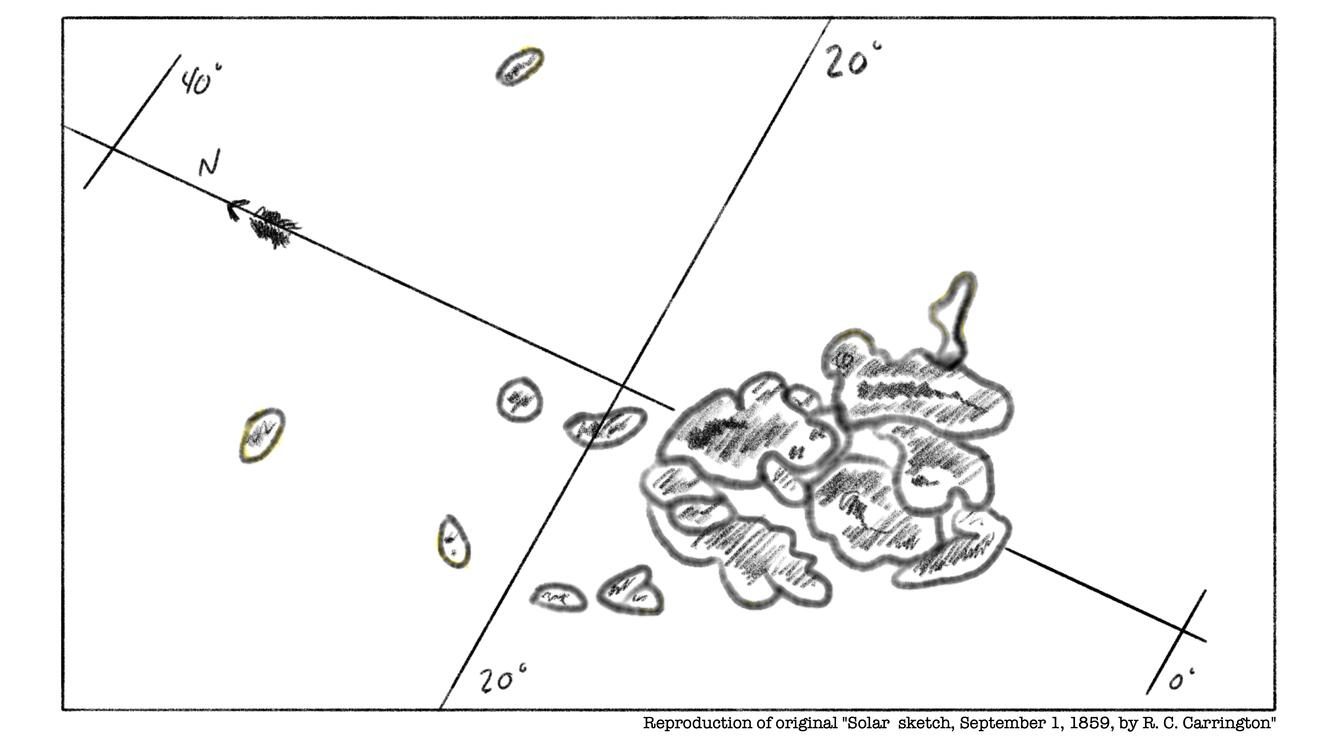
Even with the shield in place, the Sun can hit us hard. In 1859, a huge solar storm known as the Carrington Event struck Earth. Auroras were seen close to the equator. Telegraph lines sparked, operators got electric shocks, and some machines kept working even after their batteries were disconnected. In 1989, a much smaller storm knocked out the power grid in Quebec, leaving around six million people without electricity for about nine hours.
In 2022, a moderate storm heated and expanded Earth's upper atmosphere just as SpaceX launched a batch of Starlink satellites. The extra drag pulled thirty-eight of them back down to burn up. All of that happened with the magnetic field working perfectly. Now imagine it was gone.
A world without the field
First, some good news. We wouldn't all die overnight. Our thick atmosphere would still block most of the dangerous radiation from reaching the ground. You wouldn't suddenly burn or glow. But the world would change fast.
Compasses would be useless. Auroras could appear almost anywhere on Earth, even near the equator, during every strong solar storm. The real damage would happen above our heads.
Satellites would be blasted by far more radiation, frying electronics and shortening their lives. GPS, weather forecasts, communications, and banking systems all depend on them. Power grids would face storms like Quebec's again and again, with nothing to soften the blow. Astronauts and airline crews would take much higher doses of radiation. Flights over the poles are already rerouted during big solar storms. Without the field, that problem would spread everywhere.
Some studies also suggest that more energetic particles pouring into the upper atmosphere could thin the ozone layer, letting more of the Sun's ultraviolet light reach the ground.
Life that navigates by it
And we're not the only ones who depend on it. Many animals have a built-in magnetic sense. Sea turtles use the field to find their way across entire oceans and back to the beach where they hatched. Migrating birds use it to navigate thousands of kilometres. Salmon use it to find their home rivers.
Some scientists even suspect that disturbances in the field may play a role in some whale strandings. Without the magnetic field, countless species would lose one of their most important guides.
The slow loss: Mars
And over a much longer time, something even bigger could be at stake. Our air. Look at Mars. Billions of years ago, Mars had a magnetic field, a thicker atmosphere, and liquid water on its surface. Then its core cooled, and its field faded away.
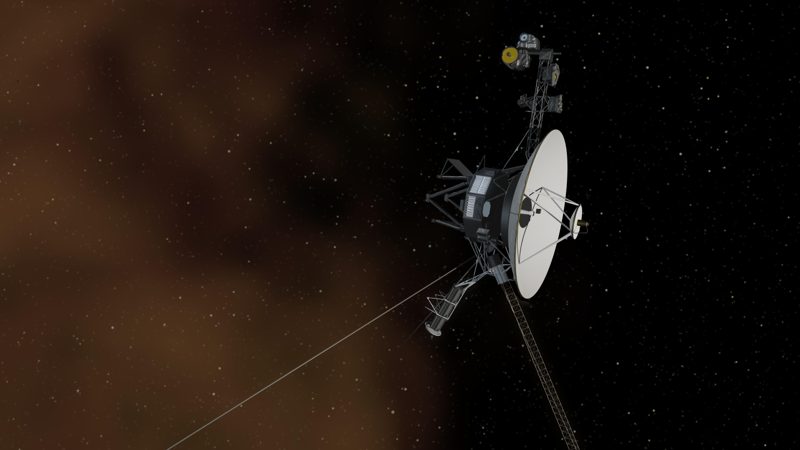
NASA's MAVEN spacecraft has measured the solar wind stripping gas from the top of the Martian atmosphere, a little at a time. Over billions of years, that helped turn Mars into the cold, dry desert we see today. Could the same thing happen to Earth? Scientists are still debating how much a magnetic field really protects an atmosphere. Venus has no magnetic field of its own, and yet its atmosphere is incredibly thick.
But even if Earth did slowly lose air, it would take hundreds of millions of years. No one alive would ever notice.
It has happened before
Here's the surprising part. Earth's magnetic field has collapsed before. And humans were there to see it. About forty-one thousand years ago, during an event called the Laschamps excursion, the field dropped to roughly a tenth of its strength. For a few centuries, the poles even wandered and flipped. We know because the rocks and ice remember. Lava that cooled at the time recorded the strange field. And ice cores show that cosmic rays hit the atmosphere about twice as hard as they do today.
A 2025 study modelled what the sky would have looked like. Auroras could have shimmered over large parts of the planet. The same study suggested that early humans may have responded. Using more ochre on their skin, perhaps as a kind of sunscreen. Wearing more tailored clothing. Spending more time in caves. It's only an idea for now, and many researchers aren't convinced. But it's a fascinating one.
And it wasn't a one-off. In 1906, a French scientist named Bernard Brunhes found volcanic rocks that were magnetised in the opposite direction to today's field. It was the first clue that Earth's poles can swap places. Fifty years later, ships towing magnetometers across the oceans found something even stranger. The seafloor is striped. As new crust forms at mid-ocean ridges and cools, it locks in the direction of the field at that moment. Stripe after stripe, the rocks record the field flipping back and forth, again and again.
Earth's magnetic poles have fully flipped hundreds of times. The last full reversal happened about seven hundred and eighty thousand years ago. Life survived every single one.
Is it happening now?
So what is our shield doing right now? It's getting weaker. Over roughly the last one hundred and seventy years, Earth's magnetic field has lost around nine percent of its strength. And there's a growing weak spot over South America and the South Atlantic, called the South Atlantic Anomaly.
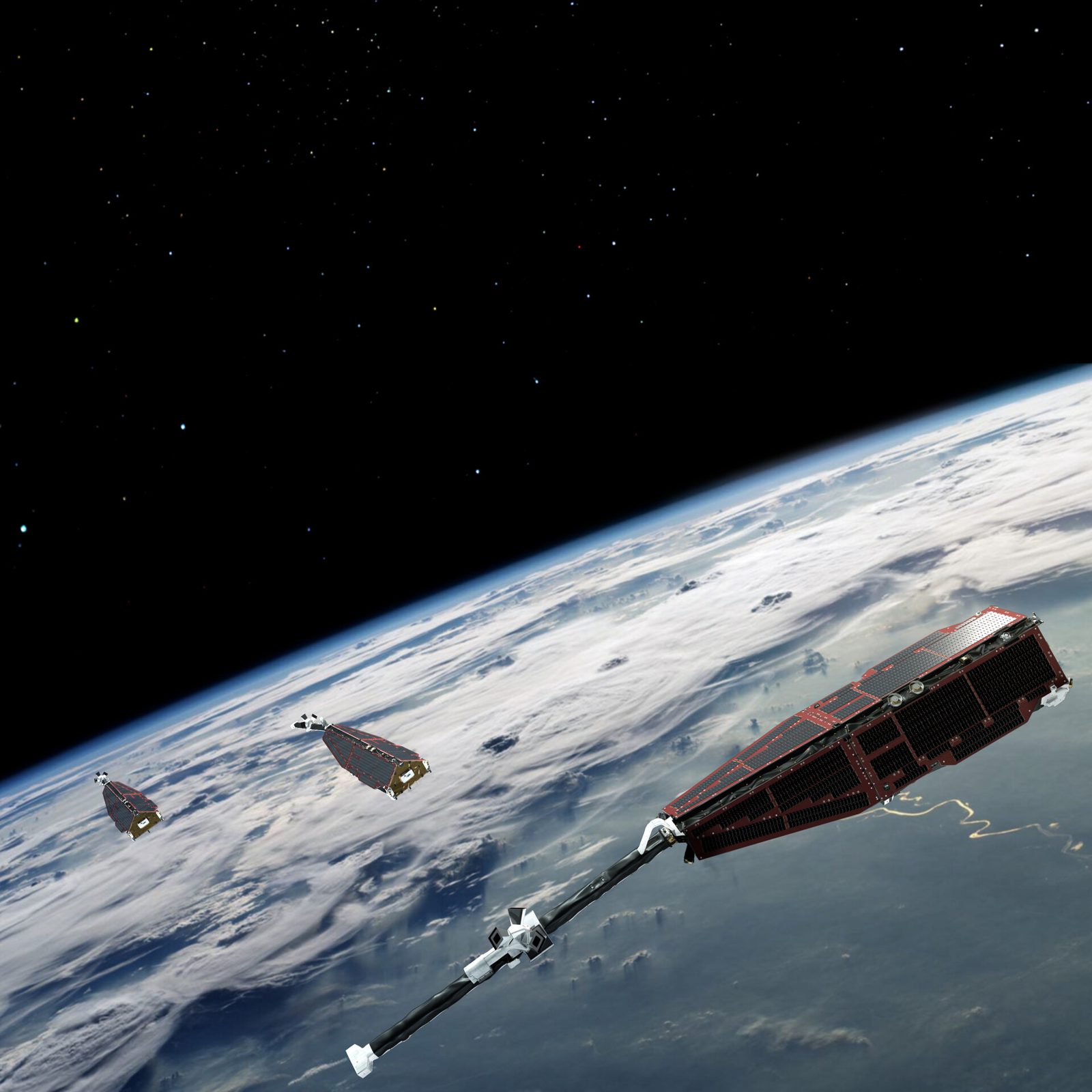
In 2025, the European Space Agency's Swarm satellites showed that since 2014, this weak region has grown by an area nearly half the size of continental Europe. Satellites passing through it already suffer glitches. The Hubble Space Telescope doesn't even take observations when it flies over it. Meanwhile, the magnetic north pole is on the move. For decades it has been drifting away from Canada toward Siberia, at up to fifty-five kilometres a year.
The answer
So are we heading for a flip? Nobody knows. Reversals don't follow a schedule. Sometimes they come close together, and sometimes millions of years pass without one. The field has weakened before without flipping at all. And even if a reversal has started, it would take thousands of years to play out. It wouldn't happen overnight, and the field would never fully switch off.
Instead, it would get messy. The field would weaken, and several north and south poles could pop up in different places around the globe. Compasses would point in strange directions, and auroras would appear where no one had ever seen them before. Then, slowly, the field would settle again, pointing the other way. Earth's core has enough heat to keep the dynamo running for billions of years to come. Earth is not going to become Mars.
But the next time you see the northern lights, remember what you're really looking at. Thousands of kilometres beneath your feet, an ocean of liquid metal is spinning. And far above your head, the field it creates is fighting the Sun, every second, so that life down here can carry on. It's the shield we never see. And without it, Earth would be a very different world.
This article is adapted from our documentary.
Watch on YouTube