Planets & moons · 8 min read
What New Horizons Found at Pluto
For 85 years Pluto was a smudge. Then New Horizons flew past and found a living world with a heart of nitrogen ice, blue skies and mountains of water ice.
Pluto in true colour. NASA/JHUAPL/SwRI
In this story
For eighty-five years, Pluto was a smudge. A few pixels of light, at the edge of our solar system. Even the Hubble Space Telescope could barely make out anything on its surface. Most scientists expected a dead world. A frozen, cratered ball of ice, unchanged for billions of years.
Then, on July 14th, 2015, a spacecraft the size of a piano flew past it at fifty thousand kilometres an hour. And what it saw changed everything we thought we knew about the edge of the solar system. This is the story of New Horizons, and what it found at Pluto.
Discovery
The search for Pluto began with a man you might remember from the story of Mars. Percival Lowell, the astronomer who believed in Martian canals, was also convinced there was another planet hiding beyond Neptune. He called it Planet X. He searched for it for years, and died in 1916 without finding it.
But his observatory in Arizona kept looking. In 1929, it hired a twenty-two-year-old farm boy from Kansas named Clyde Tombaugh. He had no university degree. He had built his own telescopes, and sent his drawings of Mars and Jupiter to the observatory. His job was painstaking. He photographed the same patch of sky on different nights, then flicked between the images, looking for one tiny dot that had moved.
On February 18th, 1930, he found it. The new world needed a name. The winning suggestion came from an eleven-year-old schoolgirl in England, named Venetia Burney. She suggested Pluto, the Roman god of the underworld. It fit a dark, cold world far from the Sun. And its first two letters, P and L, were the initials of Percival Lowell.
Pluto by the numbers
For decades, Pluto stayed a mystery, because it is so small and so far away. It's only about 2,380 kilometres across. That's smaller than our own Moon. It orbits the Sun at an average of around 5.9 billion kilometres, nearly forty times farther than Earth.
At that distance, sunlight is more than a thousand times weaker than it is here. The surface sits at around minus two hundred and thirty degrees Celsius. A single year on Pluto lasts 248 Earth years. Since it was discovered, it hasn't even completed one orbit. It won't until the year 2178. And it isn't alone. Pluto has five moons. The largest, Charon, is about half its size. The two are so close in size that they orbit a point in space between them, like a pair of dancers spinning while holding hands.
To really understand Pluto, there was only one option. Go there.
The mission
On January 19th, 2006, New Horizons launched from Florida on an Atlas V rocket. It was the fastest spacecraft ever launched from Earth. It passed the orbit of the Moon in about nine hours. A trip that took the Apollo astronauts three days. It weighed less than five hundred kilograms. Out at Pluto, solar panels would be useless, so it ran on heat from a small block of plutonium.
A year later, it swung past Jupiter, using the giant planet's gravity to steal even more speed, and to shave years off the journey. Then it slept. For most of the next eight years, New Horizons spent long stretches in hibernation, waking up only for check-ups, as it crossed billions of kilometres of empty space.
Tucked inside it was something personal. A small container holding some of the ashes of Clyde Tombaugh, the man who discovered Pluto.
The demotion
But something strange happened while New Horizons was on its way. Pluto stopped being a planet. Astronomers had started finding other icy worlds out beyond Neptune, in a vast region called the Kuiper Belt. In 2005, they found one called Eris, which seemed to be about the same size as Pluto.
If Pluto was a planet, then Eris had to be one too. And there could be dozens more. So, in August 2006, just seven months after New Horizons launched, the International Astronomical Union voted on a new definition of a planet. Pluto didn't make the cut. It was reclassified as a dwarf planet.
The spacecraft had left Earth to visit the ninth planet. By the time it arrived, there were only eight. Many scientists, including some on the New Horizons team, still argue that Pluto deserves to be called a planet. And as we were about to find out, Pluto had plenty to say for itself.
The flyby
In 2015, after nine and a half years, Pluto finally started to grow from a dot into a world. And then, just ten days before the flyby, disaster nearly struck. On July 4th, the spacecraft suddenly went silent.
Its computer had been overloaded, and it had put itself into safe mode. Mission controllers had to work around the clock to bring it back. Every hour mattered, because there was no second chance. New Horizons couldn't slow down. It couldn't go into orbit. It would fly past Pluto once, and then it would be gone forever. The team brought it back with just days to spare.
On July 14th, 2015, New Horizons passed about 12,500 kilometres above Pluto's surface. During the flyby, it was too busy to talk. Every instrument was pointed at Pluto, recording everything it could. On Earth, the team waited for nearly a day to find out whether it had survived.
At Pluto's distance, a radio signal takes about four and a half hours to reach us. So when the message finally came through that night, it had been sent hours earlier. The spacecraft was alive. And it was carrying the first close-up pictures of Pluto in history.
The heart
The first thing everyone noticed was the heart. A huge, bright, heart-shaped region stretching across Pluto's surface. It was named Tombaugh Regio, after the man who discovered it. The left side of the heart is a vast plain of frozen nitrogen called Sputnik Planitia. It's about a thousand kilometres wide, bigger than France.
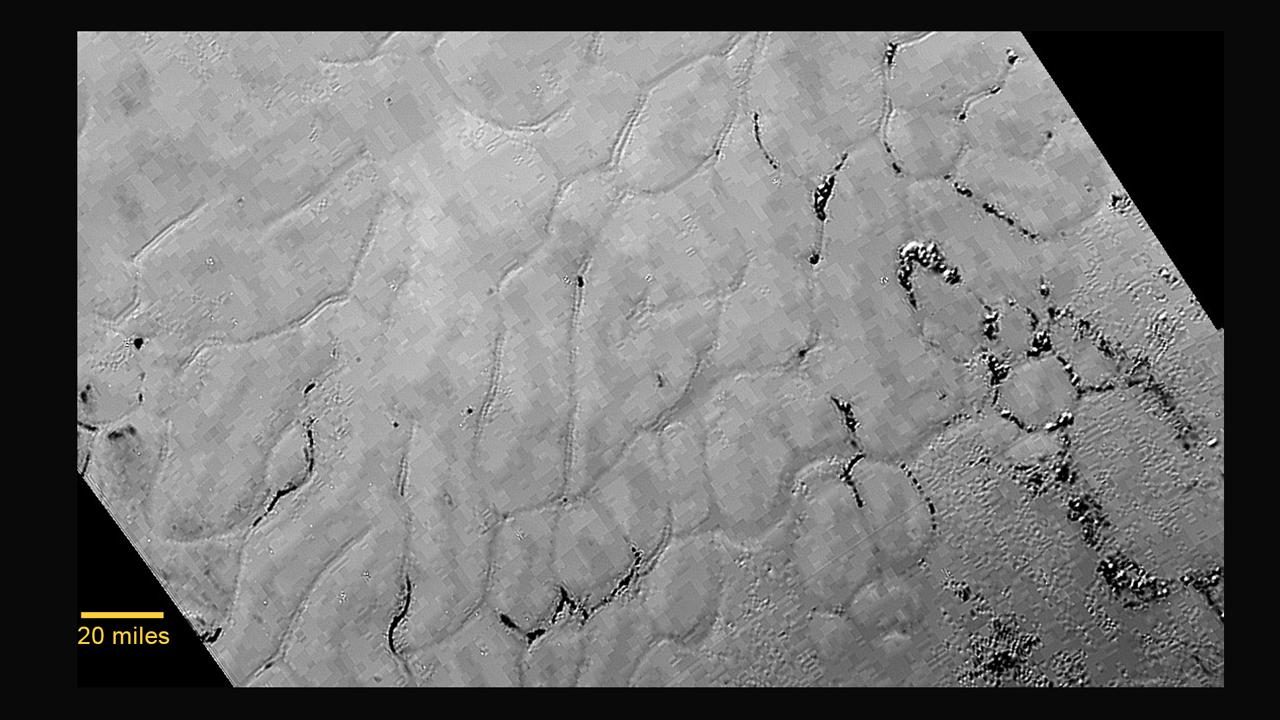
And it had a surprise. There were no craters. None. On an old world, a surface should be covered in craters from billions of years of impacts. A surface without craters must be young. Scientists estimated parts of Sputnik Planitia are less than ten million years old. In planetary terms, that's yesterday.
Looking closer, they saw why. The plain is divided into giant cells, each tens of kilometres across. The nitrogen ice is slowly churning, like a lava lamp, as warmer ice from below rises to the surface and sinks again. Pluto, it turned out, wasn't frozen in place. It was moving.
A living world
Around the edge of the heart rise mountains several kilometres tall. They're made of water ice. On Pluto, it's so cold that water ice behaves like rock. It's the bedrock the whole world is built on. Rivers of nitrogen ice flow down from the highlands like glaciers, into the plain below.
Then, as New Horizons flew past and looked back toward the Sun, it saw something nobody expected. Pluto has a sky. A thin atmosphere wraps around it, with around twenty layers of haze stacked high above the surface. And when sunlight shines through it, the haze glows blue.
There were even signs of volcanoes. Not volcanoes of lava, but of ice. Scientists think a huge mountain called Wright Mons may be a cryovolcano, which once erupted a slushy mix of ice and water from deep inside. In other places, the ground is covered in giant blades of methane ice, some as tall as skyscrapers, lined up in rows across the landscape. But the biggest surprise was what might be hiding underneath.
Sputnik Planitia sits in almost exactly the spot you would expect if something heavy had settled there over time, pulling Pluto into a new position. One of the best explanations is a liquid ocean, hidden beneath the ice. A dwarf planet, nearly six billion kilometres from the Sun, may have liquid water inside it.
Charon
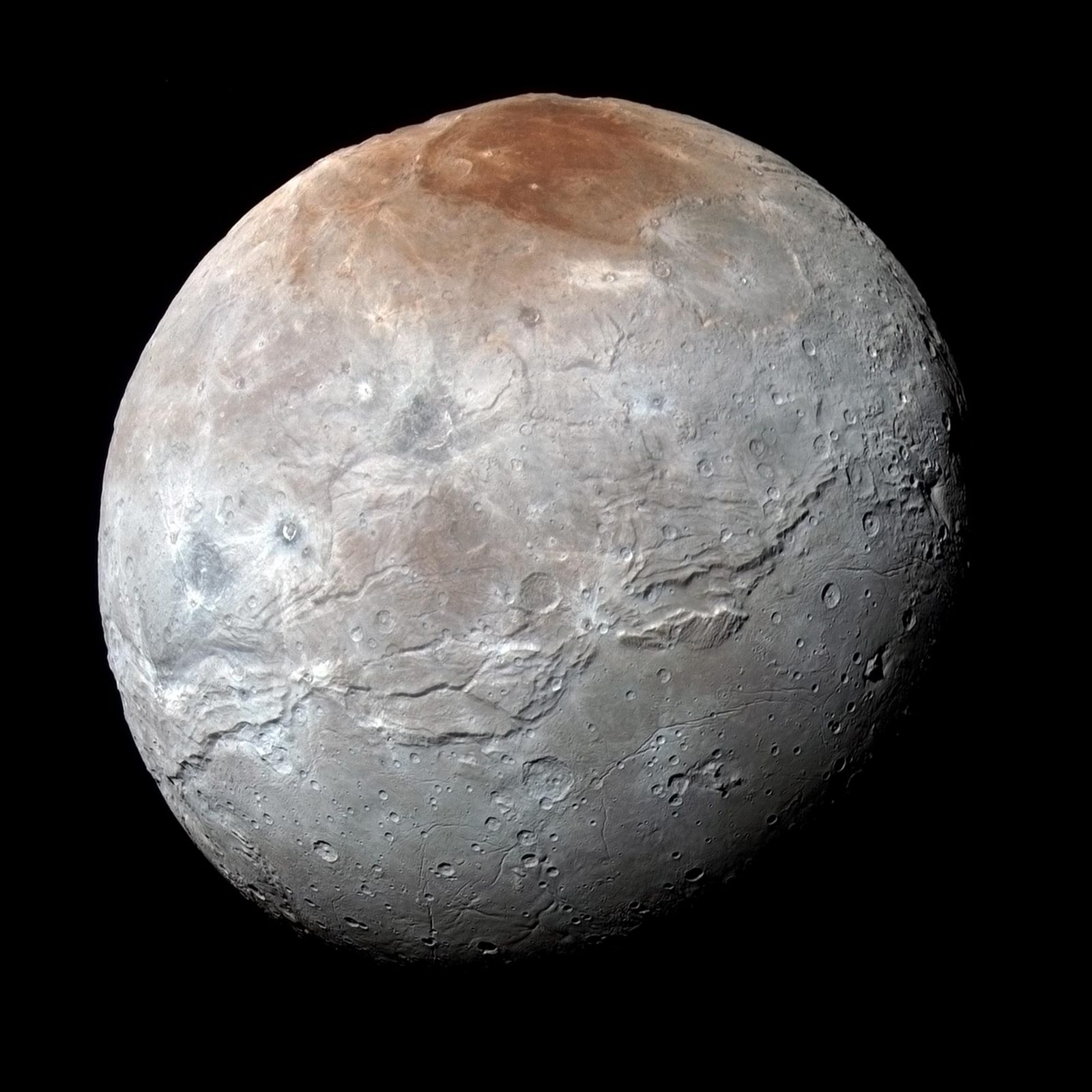
Charon turned out to be just as strange. Across its middle runs a system of canyons four times as long as the Grand Canyon, and in places four times as deep. It looks as if the whole moon expanded and cracked, perhaps when an ocean inside it froze. At its north pole sits a dark red cap. Scientists nicknamed it Mordor.
And the colour comes from Pluto. Gas slowly escapes from Pluto's atmosphere. Some of it drifts across and gets trapped on Charon's frozen pole. There, sunlight slowly turns it into reddish material. Pluto is painting its own moon. More recently, the James Webb Space Telescope found carbon dioxide and hydrogen peroxide on Charon's surface.
And in 2025, a study suggested how the two came together in the first place. Billions of years ago, they may have collided slowly, stuck together for a moment, and then separated, a kind of cosmic kiss that left them locked together ever since.
Arrokoth
After Pluto, New Horizons kept going. On January 1st, 2019, it flew past a small object in the Kuiper Belt called Arrokoth, about 6.6 billion kilometres from Earth. It's still the most distant object any spacecraft has ever visited.
Arrokoth is only about 36 kilometres long. It's made of two rounded lobes, gently joined together, like a snowman that's been squashed flat. That shape is a clue. The two pieces must have come together very slowly, without smashing apart. They've barely changed since the solar system formed, more than four and a half billion years ago. It's like looking at one of the original building blocks of the planets.
And it took nearly two years to send all the data home. Out there, it transmits slower than an old dial-up modem.
Still flying
Today, New Horizons is more than nine billion kilometres from Earth, and still heading out of the solar system. It still has enough power to keep working for many years. Eventually, like the two Voyager spacecraft before it, it will cross into interstellar space. Before it left Pluto behind, it turned around and took one last picture. Pluto as a thin crescent, lit from behind by a Sun that looks like a bright star, with its blue haze glowing around the edge.
For eighty-five years, Pluto was just a dot. We thought it would be dead. Instead, we found glaciers, mountains, a blue sky, and maybe even a hidden ocean. Somewhere on that spacecraft, still travelling outward, are the ashes of Clyde Tombaugh.
The man who found Pluto finally got to visit it.
This article is adapted from our documentary.
Watch on YouTube