Planets & moons · 10 min read
Mars Had Oceans. Where Did They Go?
Billions of years ago Mars had rivers, lakes and maybe an ocean. The evidence, the culprit, and what the rovers are finding now.
Mars. NASA
In this story
Venus burned. Mars froze.
Two worlds on either side of us. One became a furnace. The other became a frozen desert. And for a long time, we thought Mars had always been that way.
We were wrong.
Billions of years ago, Mars had rivers. It had lakes. It may have had an ocean covering a third of the planet. Today, there's almost no liquid water left on its surface at all.
So where did it go?
A light in the sky
For thousands of years, Mars was just a light in the sky. A small, rust-coloured point that wandered slowly between the stars. The Romans named it after their god of war, because of its colour. The colour of blood.
But that colour has a simpler explanation. The Martian surface is covered in fine dust rich in iron oxide. In other words, Mars is red because it's rusty. And in twenty twenty five, one study suggested something even more interesting. The rusty mineral in that dust may be one that forms when there's cool water around.
In eighteen seventy seven, the Italian astronomer Giovanni Schiaparelli drew maps of Mars covered in long, straight lines. He called them "canali", meaning channels. But the word was translated into English as "canals". And canals have to be built by someone.
An American astronomer named Percival Lowell became convinced of it. He spent years drawing a network of canals across the planet, and wrote that an ancient Martian civilisation had built them to carry water from the poles to the dying deserts.
It was a beautiful idea. It was completely wrong. The canals were an optical illusion, a trick of the human eye trying to connect faint details at the edge of what a telescope could see.
But Lowell got one thing right. Mars is a planet that once had water, and lost it.
Mars by the numbers
Mars is small. It's only about half the width of Earth, and it has just over a tenth of Earth's mass. Stand on its surface and you'd weigh only thirty eight percent of what you weigh at home.
A day on Mars lasts twenty four hours and thirty seven minutes, almost exactly the same as ours. But a year lasts six hundred eighty seven Earth days, because Mars sits about one and a half times farther from the Sun than we do.
That distance makes it cold. The average temperature is around minus sixty degrees Celsius. On a summer afternoon near the equator, the ground can briefly reach above freezing. At night, it can plunge below minus one hundred.
And the air is almost nothing. The atmosphere is about ninety five percent carbon dioxide, but it's so thin that the pressure at the surface is less than one percent of Earth's. If you stood there without a suit, the water in your body would start to boil, not because it's hot, but because there's barely any air pressing down on it.
A landscape of giants
Yet this small, cold world holds some of the most extreme landscapes in the solar system.
Olympus Mons is the tallest volcano we know of anywhere. It rises about twenty two kilometres high, more than twice the height of Mount Everest. Its base is so wide that if you stood at its edge, the summit would be hidden beyond the horizon.
Then there's Valles Marineris, a system of canyons more than four thousand kilometres long and up to seven kilometres deep. On Earth, it would stretch from one side of the United States to the other. It makes the Grand Canyon look like a scratch.
The evidence of water
A planet that can build volcanoes and canyons on that scale was once very active. And the more closely we looked, the more we found signs that it was once wet.
In nineteen seventy one, NASA's Mariner nine became the first spacecraft ever to orbit another planet. When it arrived, the whole of Mars was hidden under a global dust storm. When the dust finally settled, Mariner nine saw something no one expected. Dry river valleys. Channels carved by flowing water, winding across the surface for hundreds of kilometres.
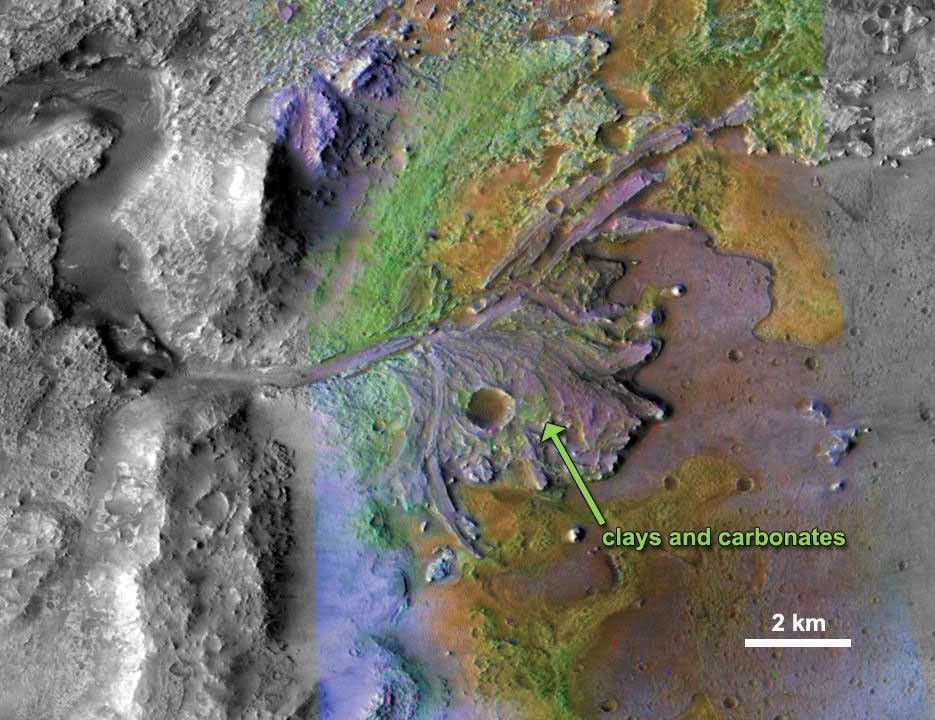
Since then, the evidence has kept piling up. Orbiters have found clay minerals that only form when rock sits in water for a long time. They've found ancient lake beds, and deltas, the fan-shaped deposits that form where a river empties into a lake.
One of those deltas sits inside a crater called Jezero. Around three and a half billion years ago, a river flowed into Jezero and filled it with a lake. That's exactly why NASA chose it as the landing site for its most advanced rover.
But the biggest question is whether Mars ever had a true ocean.
The northern half of Mars is strangely low and smooth, as if something once filled it. Some scientists think it was a vast ocean. And in twenty twenty five, China's Zhurong rover added new evidence. Using radar to look beneath the surface, it found buried layers of sediment sloping gently downward, just like the deposits that form along beaches on Earth.
If that reading is right, waves once lapped against the shores of Mars.
Where it went
So, what happened to all that water?
The answer starts deep inside the planet. Early Mars, like Earth, had a molten core that generated a magnetic field. That field acted like a shield, protecting the atmosphere from the solar wind, the constant stream of charged particles flowing out from the Sun.
But Mars is small. Small planets lose their heat faster. About four billion years ago, the core of Mars cooled enough that its global magnetic field faded away.
With its shield gone, Mars was exposed. The solar wind began stripping the atmosphere away into space, little by little, for billions of years.
NASA sent an orbiter called MAVEN to watch this happen. It found that Mars is still losing its air today, around one hundred grams every second, and even more during solar storms. It doesn't sound like much. But over billions of years, it adds up to most of an atmosphere.
As the air thinned, the planet cooled, and the pressure dropped. Liquid water can't survive for long at such low pressure. It either freezes or turns straight into vapour. And once water vapour drifted high into the thin atmosphere, sunlight could break it apart, and its hydrogen escaped into space.
But not all of the water was lost.
A lot of it is still there, frozen. Both poles of Mars are capped with ice, and much of it is water ice. In two thousand eight, NASA's Phoenix lander scraped into the ground near the north pole and found ice just beneath the surface. Orbiters have since detected buried ice across large parts of the planet.
Some of the water may have been locked away in the rocks themselves. One twenty twenty one study suggested that a large share of Mars's ancient water was absorbed into minerals in the crust, trapped there ever since.
And in twenty twenty four, scientists studying data from NASA's InSight lander made an even bigger claim. InSight had listened to marsquakes for four years. By studying how those quakes travelled through the planet, the team concluded there may be a huge reservoir of liquid water deep underground, between about eleven and twenty kilometres below the surface. Enough, they estimated, to cover the entire planet in an ocean more than a kilometre deep.
If they're right, Mars didn't lose all its oceans. Some of them may just be hiding.
Exploring Mars
Of course, we only know any of this because we kept going back. And Mars has not made that easy.
Roughly half of all the missions ever sent to Mars have failed. Spacecraft have crashed, gone silent, or missed the planet completely.
In nineteen sixty five, NASA's Mariner four flew past Mars and sent back about twenty grainy pictures. They showed a cratered, lifeless surface, more like the Moon than Earth. The dream of Lowell's canals died that day.
In nineteen seventy six, the two Viking landers touched down and became the first spacecraft to work successfully on the surface of Mars for a long time. They sent back colour photos of a rusty plain under a pinkish sky. And they carried experiments designed to look for life.
One of those experiments gave a result that looked positive. The others didn't. Most scientists concluded the reaction was chemical, not biological. But the debate has never completely gone away.
In nineteen ninety seven, a little rover called Sojourner, about the size of a microwave oven, became the first wheeled vehicle to explore another planet.
Then, in two thousand four, came the twins. Spirit and Opportunity. They were designed to last about ninety Martian days. Spirit kept going for six years. Opportunity lasted more than fourteen, and drove over forty five kilometres, before a planet-wide dust storm in twenty eighteen blocked out the Sun and cut off its power. Along the way, it found tiny round grains of hematite that scientists nicknamed blueberries. On Earth, those form in water.
In twenty twelve, NASA lowered the car-sized Curiosity rover onto the surface with a rocket-powered sky crane. Curiosity found that its landing site, Gale crater, once held a lake that could have supported microbial life. It found organic molecules preserved in ancient rock. And it detected something strange in the air. Methane, a gas that on Earth is mostly made by living things, rising and falling with the seasons.
The source of that methane is still a mystery. It could be geology. It could be something else.
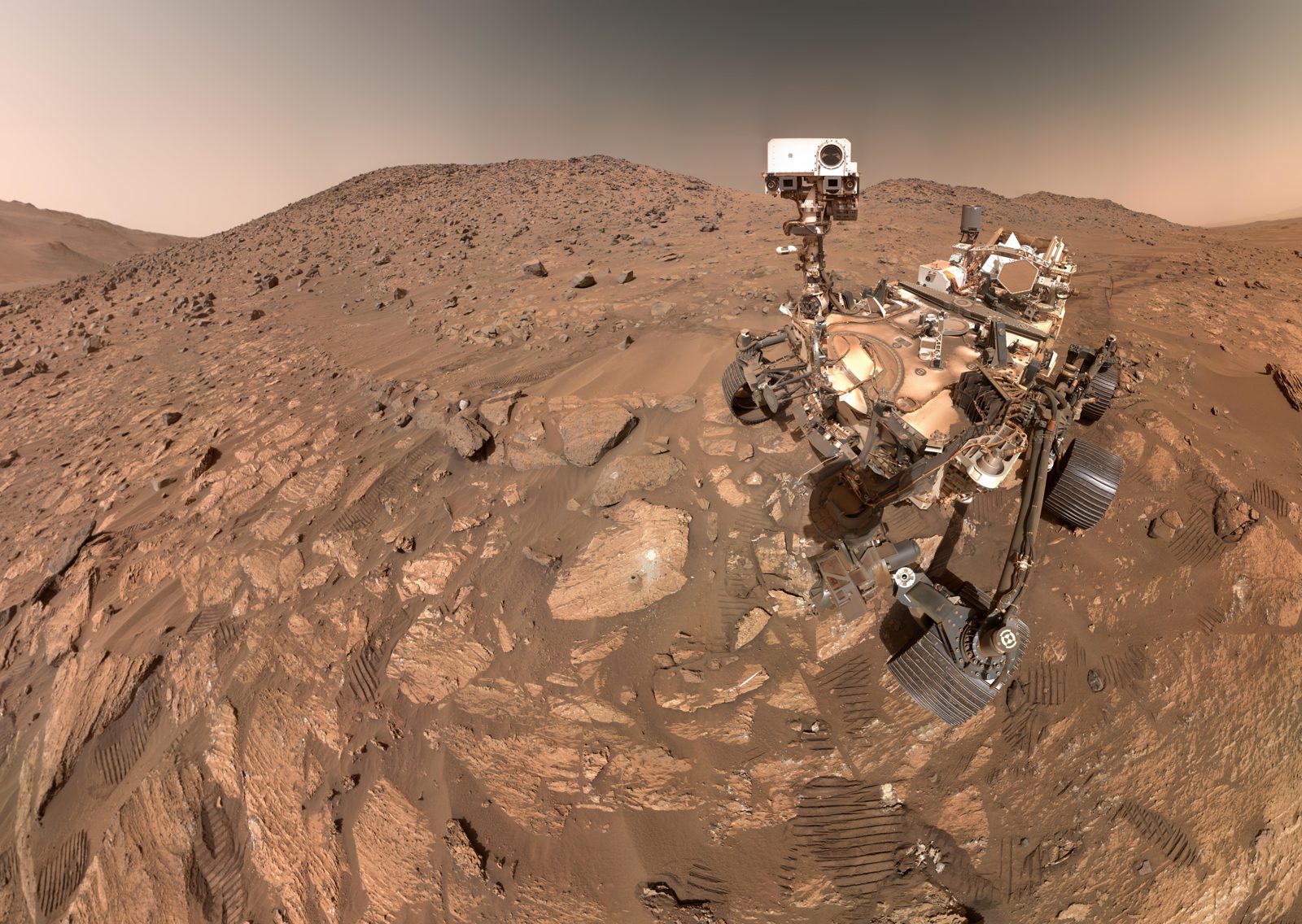
In twenty twenty one, the Perseverance rover landed in Jezero crater, right beside that ancient river delta. And it brought a passenger. A tiny helicopter called Ingenuity, which made the first powered, controlled flight on another planet. It was only meant to fly five times. It flew seventy-two.
That same year, China landed its first rover, Zhurong, becoming only the second country ever to drive on Mars.
Was there life?
Which brings us to the biggest question of all. Did anything ever live there?
In twenty twenty four, Perseverance drilled into a reddish rock that scientists named Cheyava Falls. The rock was covered in tiny dark specks they called poppy seeds, and pale spots with dark rims that looked like leopard print. Inside, the rover also found organic compounds.
On Earth, patterns like those are often left behind by chemical reactions that microbes use for energy.
In September twenty twenty five, NASA announced the results in the journal Nature. They called the sample, named Sapphire Canyon, a potential biosignature. It may be the clearest sign of ancient life we have ever found on another world.
But "potential" is the key word. Non-living chemistry might be able to produce the same patterns. To know for sure, scientists say they need to study that rock in laboratories on Earth.
What comes next
And that's the problem.
The sample is sitting in a sealed tube on Mars, waiting. NASA's plan to bring it home, called Mars Sample Return, grew more and more expensive. In twenty twenty six, the mission was cancelled in its current form.
The race isn't over, though. China is planning its own sample return mission, Tianwen-three, which aims to bring Martian rock back to Earth in the early twenty thirtys. Europe is preparing its Rosalind Franklin rover, which is designed to drill two metres beneath the surface, deep enough to reach material protected from radiation.
And then, of course, there are people.
Space agencies and private companies have spent years planning to send humans to Mars, with hopes pinned on the twenty thirtys. A human crew could do in a single afternoon what a rover takes weeks to do. They could dig, climb, collect, and look for life with their own eyes.
But they'd have to survive a world with no breathable air, deadly radiation, freezing nights, and dust storms that can swallow the entire planet.
Three worlds
Because in the end, Mars is a story about what happens when a planet loses its protection.
Venus had too much atmosphere, and it cooked. Mars lost its atmosphere, and it froze. Both may once have had water. Both may once have been places where life could begin.
And between them sits Earth. Big enough to keep its magnetic field. Far enough from the Sun to avoid a runaway greenhouse. Close enough to keep its oceans liquid.
Three planets that started out with so much in common. Only one of them is still blue.
And somewhere beneath the red dust of Mars, frozen in its ice, locked in its rocks, maybe even hidden deep underground, the answer to one of our oldest questions may be waiting.
Are we alone?
This article is adapted from our documentary.
Watch on YouTube